June 12: My sister Dianne and I are in Boston visiting her daughter Tara. Why — all of a sudden — are the hotel prices so high? Is there some, uh, world sporting event happening in North America right now? In the U.S.? In Boston? (We chose this weekend because the Boston Red Sox are playing at home…)
Sure, we saw lots of men in kilts on the train yesterday. And people with lovely accents were all around us in the hotel lobby. A nice man from Scotland helped us with our elevator keycards last night. Then this morning we saw — everyone!
So much fun to be in a World Cup city!! Go Scotland — and whatever team YOU are rooting for.

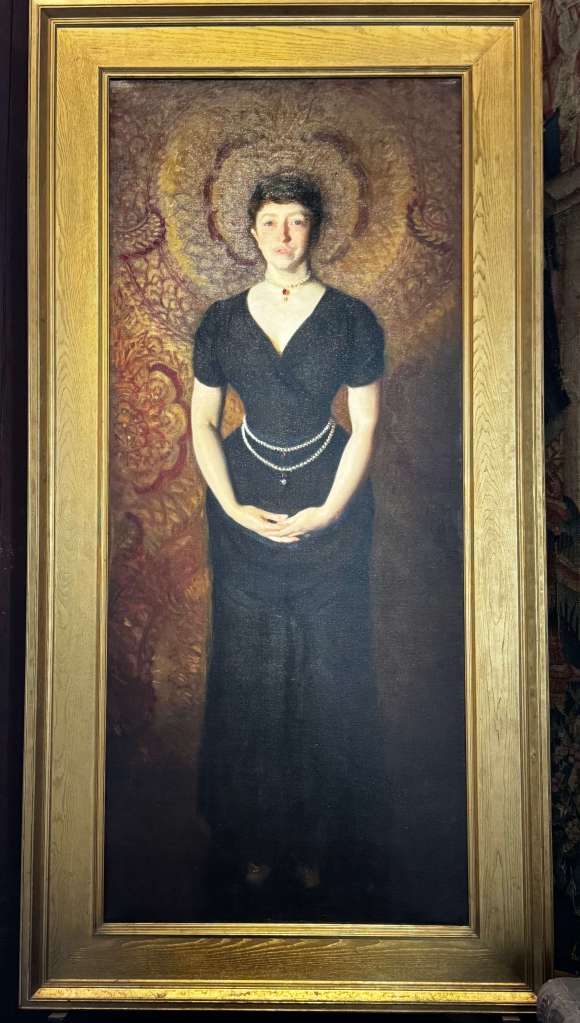
June 13: Today, my sister and niece joined me at Boston’s Isabella Stewart Gardner Museum, which offered us a banquet of Greek and Roman antiquities, Asian art and Renaissance objects, medieval cloisters and Venetian palaces, Spanish tiles and Italian textiles — along with John Singer Sargent and Rembrandt.
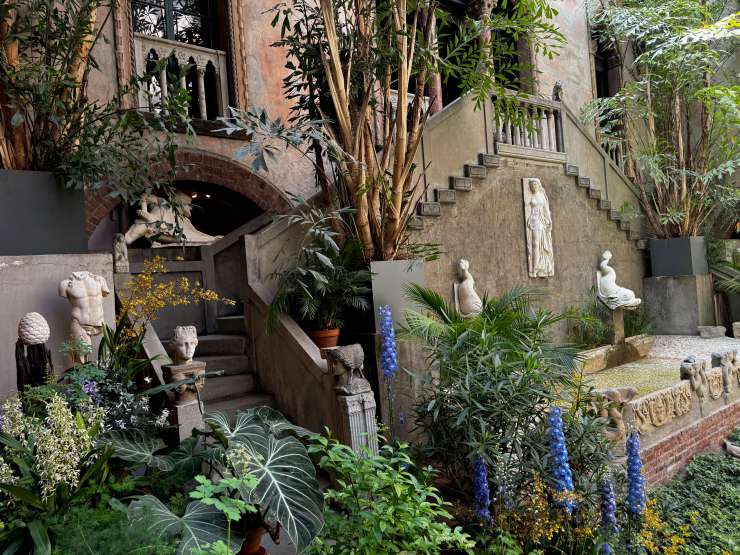
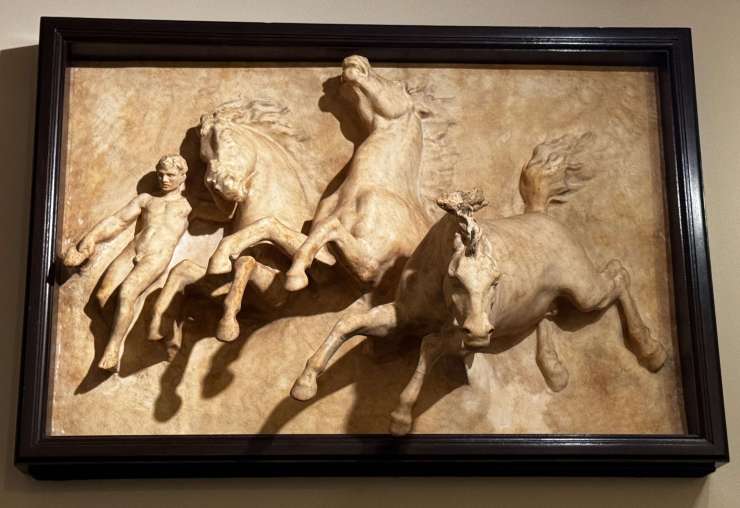
I think of Isabella Stewart Gardner (1840-1924) as a woman who collected, cultivated and curated surprise. She paired leather-tooled wall panels with Belgian lace. She draped church vestments over a chair and propped an icon of a saint on its lap. She installed a plain brown frame around sculpted horses surging out of stone. She mounted 19th century plumbing fixtures on a Roman basin. She squeezed the triangular shape of a lunging Roman warrior under a Venetian-style arch.
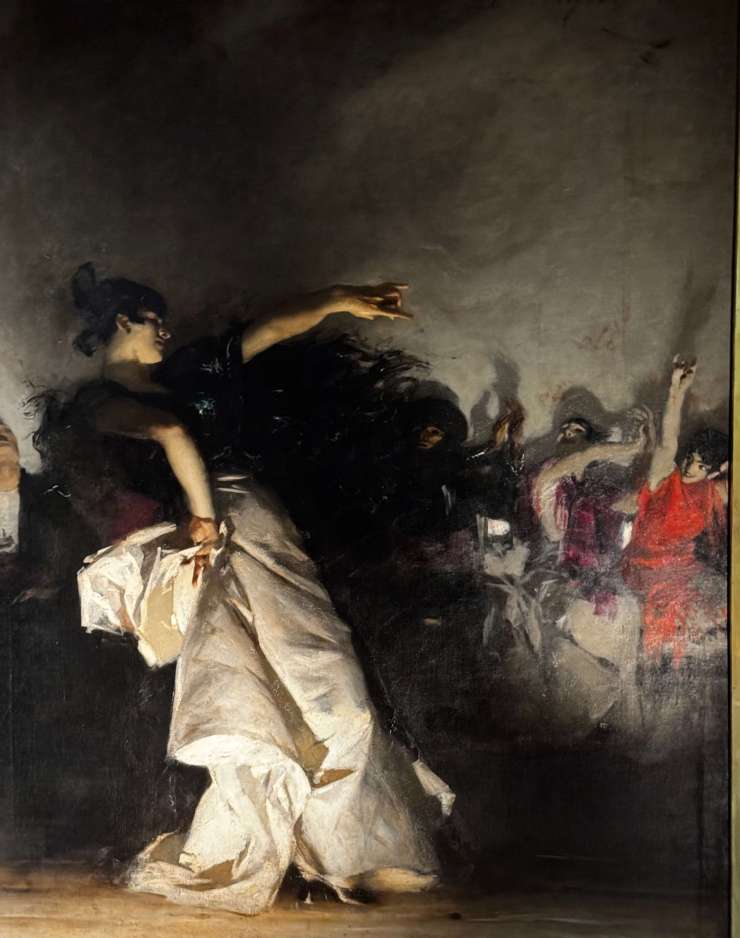
Isabella Stewart Gardner spent decades building and perfecting not only her art collection, but also the very particular presentation of it. For example, she paired Sargent’s El Jaleo with Moroccan tiles and Spanish pottery, and augmented them with a massive mirror placed at right angles. She installed a bronze sculpture of a pigeon on her palazzo window sill. She situated — in the very corner of the room — a painting on an otherwise empty wall to echo the window inches away.
And she left very specific instructions in her will to make no permanent changes to the museum displays.
I just finished reading an engaging biography of Isabella Stewart Gardner entitled Chasing Beauty, by Natalie Dykstra. Her brilliant, idiosyncratic, breathtaking collection tells her story too, exactly as she intended.
June 14: Confession: even though I’m technically a New York Knicks fan, I didn’t follow the NBA postseason very closely until we were all reminded (repeatedly) that the Knicks hadn’t won a championship since 1973.
Hmmmm, 1973. I recall that team vividly: Frazier, Reed, Monroe, Bradley, DeBusschere, Lucas, Jackson and more. I also recall my Dad phoning my hotel room — during my Washington, D.C., eighth grade class trip! — to tell me the happy news.
I rarely summon this memory. And when I do, I don’t want to verify it. Could this simply be a “memory” conjured from likely things my Dad would have done? Better to leave it alone.
Today, though, while reading every article I could find about the 2026 Knicks’ championship, I decided I needed to know. The internet, of course, could not report the dates of the 1973 Shrewsbury Grammar School eighth grade class trip, but I did remember my Dad calling me at the hotel on my birthday. If my Dad had indeed phoned me the following night about the Knicks, I now had a verifiable date.
Hey, Google, what day did the Knicks win their 1973 championship? I typed and held my breath: May 10, 1973. Verification complete.
So, Dad, thank you for navigating the hotel switchboard to make sure I knew about the Knicks. Thank you for sharing my joy. And thank you — in such a characteristic way — for seeding a memory that would bloom so many years later.

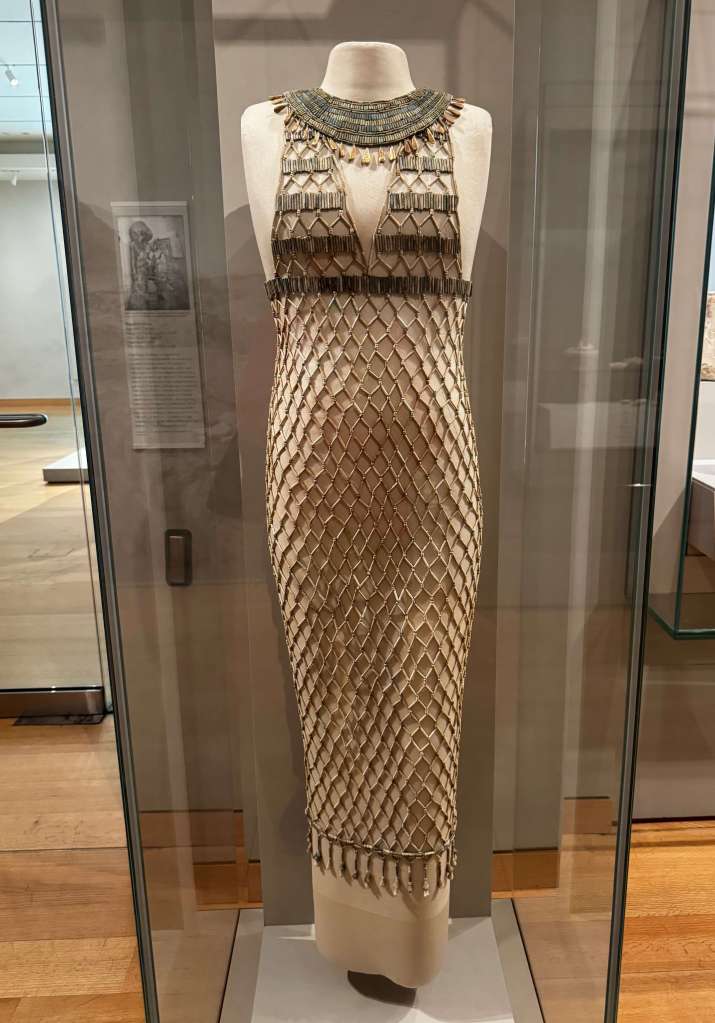
June 15: Apparently, I make a habit of going sightseeing when the Knicks win championships. Yesterday, after I finally stopped Knicks-scrolling, we all visited Boston’s North End for Italian cookies and then traveled a few transit stops to the Museum of Fine Arts. Among many many treasures, I relished an Egyptian funerary gown, painstakingly reconstructed bead by tiny bead.
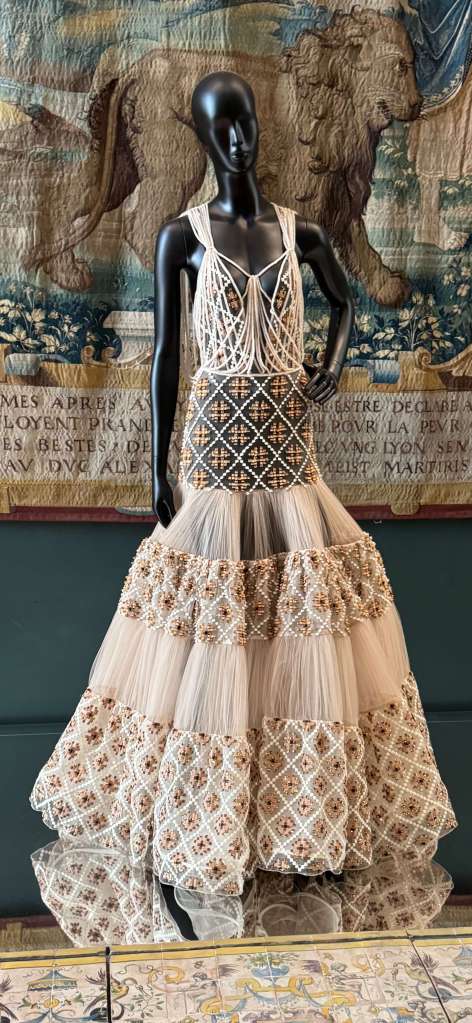
More than 4,500 years old, the “beadnet” dress had been found in 1927 draped over the mummified remains of a female contemporary of King Khufu, builder of the Great Pyramid of Giza. Although the strings had disintegrated, the beads’ pattern remained. In my opinion, its beauty is worthy of Italian haute couture.
June 16: Waking up in my own bed. Exercise. Coffee with a dear friend. Taking a nap. (A perfect day comes in many forms.)
June 18: “Where does she find all that energy?” The more apt question right now is, “Where did she leave all that energy? Why is she lying on her living room floor, flat as a pancake?”
So, yes, donning the label Last-Minute Lucy, I scurried yesterday to a stunning (and soon-closing) exhibition highlighting the influence of Spanish surrealist Joan Miró on mid-century American abstract art. The exhibition rewarded very slow looking. Which was good, because I lacked stamina for any other kind.
Then off to a baseball game and home, where I crumpled in a heap.
So maybe “doing” flat-as-a-pancake today is a good thing. Especially when I use unfolded laundry as my pillow.
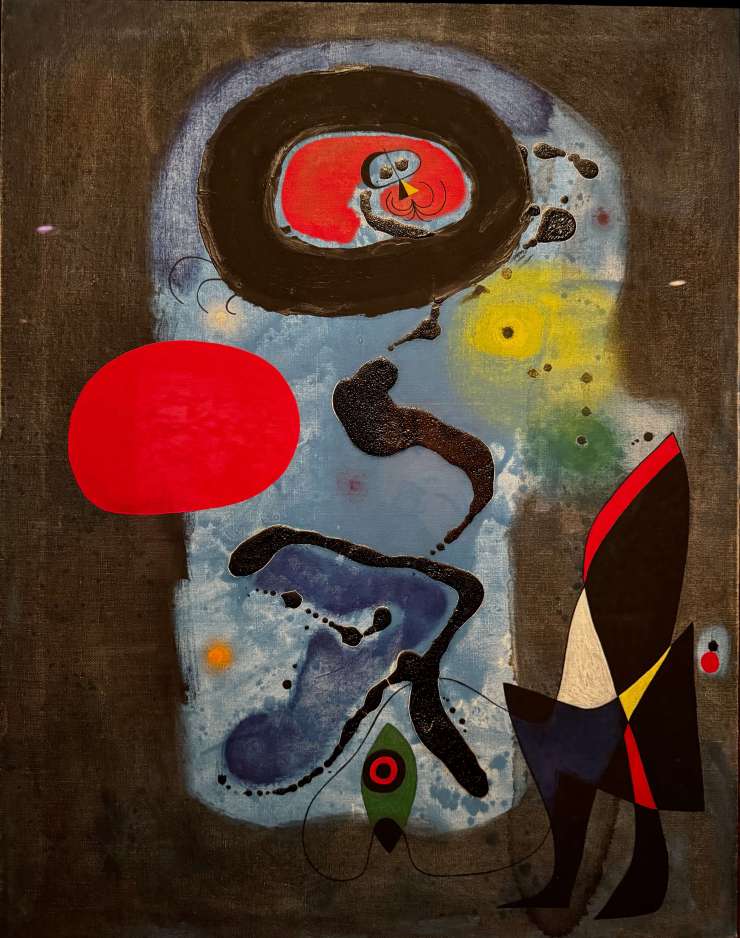
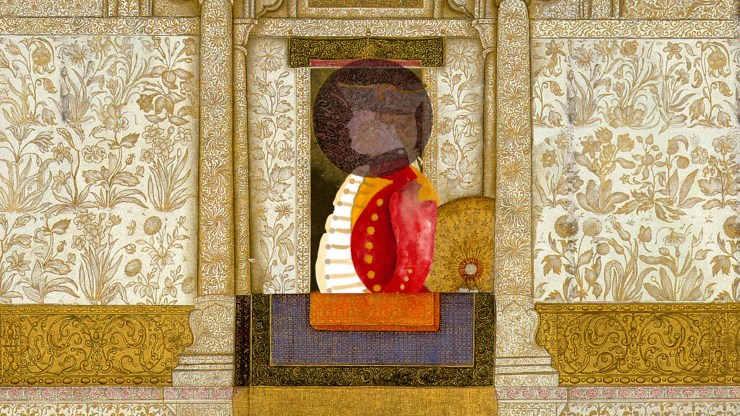
Bonus: That Miró painting reminds me of the 2010 video installation The Last Post, by Shahkia Sikander, at the Smithsonian American Art Museum.
Readers, to receive notifications by email each time I make a post, just scroll all the way down this page (next to the “word cloud”), look to the left and click on the black button that says “Join Me!” And if you think a friend might enjoy these, please share the Delight!
If you’d like to browse my past delights, please consult the “word cloud” featured at the very bottom of this post. Find a theme or two that interests you and sift through the sands. Or learn a bit more about my Blog by visiting my Welcome page. You’ll also see links to four essays that were published in print magazines. I’m glad you’re here!


I read your response to Isabella Stewart Gardner’s collection with great interest. It is an ongoing conversation around curator as artist. I am curious as to your opinion on this as a docent and art aficionado.
LikeLiked by 1 person
I love this invitation, Ju-Lyn. I’m fascinated by this too — a collaboration? an appropriation? simply a conversation? Like you, I prefer the “conversation” label, because I think that’s what curators seek. And as a docent, it’s what I try to foster. I love to invite my guests to think not only about the artist’s choices in making the object, but also the curator’s choices in placing it here, in the company of that.
This autumn, SAAM is reopening its many galleries dedicated to 18th, 19th and early 20th century art. The curators are already telling us that they will promote many conversations among those pieces and with contemporary art mixed in. So many ways of telling a story and promoting deep critical thinking!
What are your thoughts about this?
LikeLike
Thank you for sharing your visits to these wonderful places in Boston. It’s one of my favorite cities. Great photos of the museums. And great fun with the Scots taking over the city!
LikeLiked by 1 person
Yes, that’s right, I do remember your many photos of Boston and your connections there. 😊 The weather was scorching hot, but we had a great time. (Being from Washington DC, neither heat nor humidity slows me down!) I loved the compactness of the city, its terrific T, the open space and the people-sized buildings (not to mention art, culture, history, sports and food). And yes, the Tartan Army made it even more fun!
LikeLiked by 1 person
Boston sounds like a fine city to visit, and I love the museums. I recognise that flat feeling afterwards too. I’m still shaking mine off xx
LikeLiked by 1 person
It’s so lovely to hear from you, Jo! I just popped over to your blog and saw that you just completed the pilgrimage of Santiago de Compostela. WOW. I bet you’re feeling exhausted — and energized at the same time. What an experience!
I loved your photos, your text and the vivid description of the pilgrims reaching their destination, in all shapes of physical relief. And the gardens too. I salute you and look forward to reconnecting with you.
LikeLike
I was on an organised tour in Galicia, hon, and only did the last 8 km of the walk. I wanted to see the city but didn’t want to commit to the full walk xx
LikeLiked by 1 person
That’s a perfect approach!
LikeLike
That beadnet dress is extraordinary, and is evidence that our ancient forebears had skills that would have a ready market amongst the rich and famous in the 21st century. It also tells us something about the ancient Egyptian economy, which could clearly generate sufficient excess capital to enable craftsmen (craftspeople?) to devote enormous amounts of time to making things of great beauty that have little if any practical purpose.
It’s interesting that you came face to face with fans of the soccer World Cup. The tournament is getting huge media coverage here, both Scotland and England having qualified to compete. Sadly I fear it will all end in tears – nothing unusual there, I’m sorry to say!
LikeLiked by 1 person
Thank you for appreciating the bead funerary gown. I recalled it vividly from a visit to the MFA/Boston my family made back in 2010, and I was thrilled it’s still on display. Thanks, also for saluting the craftspeople. One of the places I did not visit when I was in Egypt was the workers’ village that’s recently been excavated. I’m awed that the Pharaohs spent so much on funerary wares, jewelry, tomb art and other things. Although nothing for the masses, I’m happy for the artists and craftspeople!
My encounter with the Scots was definitely a highlight. It’s all about the experience, uh, right?
LikeLiked by 1 person
The beadnet dress is exquisite! Wowsah! That Tartan Army sounds like such a blast, pun intended. (Oddly enough, this Franco-American Mainer loves bagpipes) Wonderful story about your father calling you. Glad you were able to verify it. Just reading about all that you do makes me feel “flat as a pancake.” I do admire your energy!
LikeLiked by 1 person
Thank you, Laurie, for loving what I love and for feeling what I feel! (Rest and vacation coming…..)
LikeLiked by 1 person
XXOO
LikeLike
Sargent’s El Jaleo is stunning and so interesting about that whole collection.
Although I have zero Scottish blood, I was born and grew up in Scotland and naturally follow the football team. The Tartan Army are great ambassadors too. Two of my great nephews and one of my nieces were at the match in Boston. Apparently, the noise of the singing was louder than normal….
LikeLiked by 1 person
I was definitely thinking of you, Barbara, when I posted about the Tartan Army! How thrilling that some of your family was in Boston while I was there. The Scots absolutely brightened everything and introduced joy to every encounter.
The singing? Well, at our Friday night baseball game, before I really absorbed what was happening, we encountered a lot of singing. Maybe the Red Sox fans do things differently here? NO — it was the Scots, and only a few of them. I read that Sunday’s baseball game was as loud as a concert!
LikeLike
Apparently the singing of ‘Flower of Scotland’ was so loud it broke records for the noise at any World Cup (or something like that). So glad The Tartan Army have made friends. I think the Norwegians have too with their rowing.
LikeLiked by 1 person