April 24: I started my school tour this morning at the Smithsonian American Art Museum (SAAM) in the usual way: by inviting my handful of 6th graders to tell me the “don’ts” and “do’s” of museum behavior. We dispensed with the “don’ts” pretty quickly but lingered on the “do’s” — do look hard at the art, do listen to your classmates’ ideas, do unleash your curiosity and, most important of all, do be fearless in forming and expressing your ideas.
I rewarded the kids with our first experience: lying flat on soothingly cool marble slabs in the Kogod Courtyard and looking up at the ceiling. What did they notice? Lots of glass and geometric shapes (“rhombuses!”), some clouds and sunshine, waviness (I taught them the word “undulate”), even Lego-like carvings tucked under the eaves of the masonry walls, which I had never noticed.
For the next 75 minutes, the 6th graders demonstrated enormous curiosity, courtesy, listening and fearlessness. They actually moaned when I said our tour was over.
I had walked into the museum tired and grouchy from springtime allergies; I left exhilarated.

April 25: Shakespeare 2, Bridgerton 0. (Kind of.)
As an early and delightful Mother’s Day present, Jeremiah joined me tonight at the Folger Shakespeare Library for a staged reading of Macbeth. This version of MacBeth, adapted and directed by Adjoa Andoh, MBE (a.k.a. Lady Danbury of Bridgerton), was created in 1936 by 20-year-old wunderkind Orson Welles for the Federal Theater Project. Welles’ production had featured the United States’ first all-black cast, a mythical Caribbean island, and Haitian voudo standing in for Scottish witchcraft.
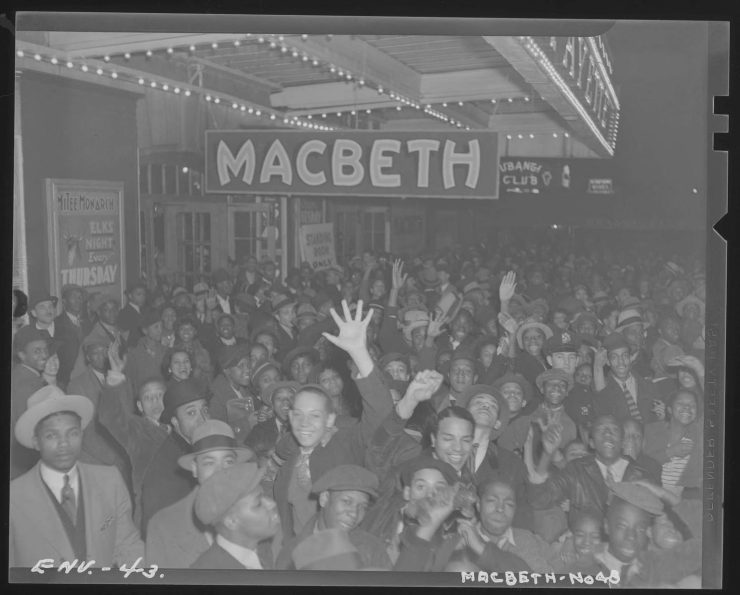
Tonight’s production was shorn of sets, costumes and staging; we were left only with Shakespeare’s words and the actors’ craft. The result, for me, was laser focus on the encroaching madness of MacBeth who, consumed by “slaughterous thoughts,” nevertheless refuses to (or is unable to) push against the forces that cause him to press on.
“I have supped full with horrors,” he says, and not even a woman’s scream alarms him. For the first time I really saw MacBeth as “a walking shadow, a poor player / that struts and frets his hour upon the stage.” I felt — not exactly sympathy for MacBeth, but rather deep admiration for the actor playing him and sorrow for a deteriorating mind.

Bonus: Fans of HBO’s The Gilded Age will recognize the actor playing MacBeth — John Douglas Thompson — as Arthur Scott, the well-to-do pharmacist and the father of journalist Peggy Scott.
Double Bonus: Perusing Wikipedia about Orson Welles, I found this fascinating tidbit (in the words of the article) about Welles’ participation in this New Deal jobs program: “Far from unemployed — ‘I was so employed I forgot how to sleep’ — Welles put a large share of his $1,500-a-week radio earnings into his [Federal Theater Project] stage productions, bypassing administrative red tape and mounting the projects more quickly and professionally. ‘Roosevelt once said that I was the only operator in history who ever illegally siphoned money into a Washington project,’ Welles said.”
April 26: My friend Janet joined me at church this morning. Although I proudly introduced Janet to my pew neighbors, it turned out that Janet knew more people than I did, including her sister whom she spied walking up to Communion. The result for me was after-church coffee with Janet, her sister and two other women I’m delighted to have met. More people for me to greet on Sunday mornings!

April 27: I like living in a place where I can walk nearly everywhere I want to go: Bookstores, bake shops and breweries are all less than 15 minutes away. I met a woman at SAAM today who lives just like me — except from a boat. She said that, for the past five years, she, her husband and their three-bedroom catamaran have sailed into ports up and down the Eastern Seaboard and find themselves walking to fun destinations.
On the day of her visit to SAAM, her husband disembarked and caught a plane, while she walked from the Washington D.C. wharf to our museum. I wracked my brain fruitlessly for images of rivers or boats to highlight on my tour; giving up, I stuck with my usual pieces. We soon reached a “drape” painting by Sam Gilliam. Conversation eventually turned to the kind (and even the shape) of the canvas Gilliam had used. Pointing to the grommets, our sailor speculated that Gilliam had used a triangular sail cloth for his work. A triangle. I’d never considered that.
I love the way life illuminates art in surprising ways.

April 28: When I begin my adult tours at SAAM, I tell folks right away that my job is not to fill them with information (although I assure them I’ll share cool stuff) but rather to foster their engagement with each piece. For the adults in my Highlights tour today, I pulled out the words “curiosity” and “fearlessness” from my middle school kit and encouraged them, like 6th graders, to take chances.
So, pop quiz: why do I foster engagement? (a) because that’s what I’ve been taught to do; (b) because — when my head is congested with spring allergies — the more they talk, the less I have to; (c ) because I get to see familiar objects in very new ways; (d) because our group soon acquires the tools to investigate works I hadn’t planned to show — and haven’t even researched; (e) because viewers who engage thoughtfully with art have a more meaningful museum experience; or (f) all of the above.
Definitely “all of the above.” (At one point, a visitor gave me a cough drop to ease my most conspicuous symptoms.)
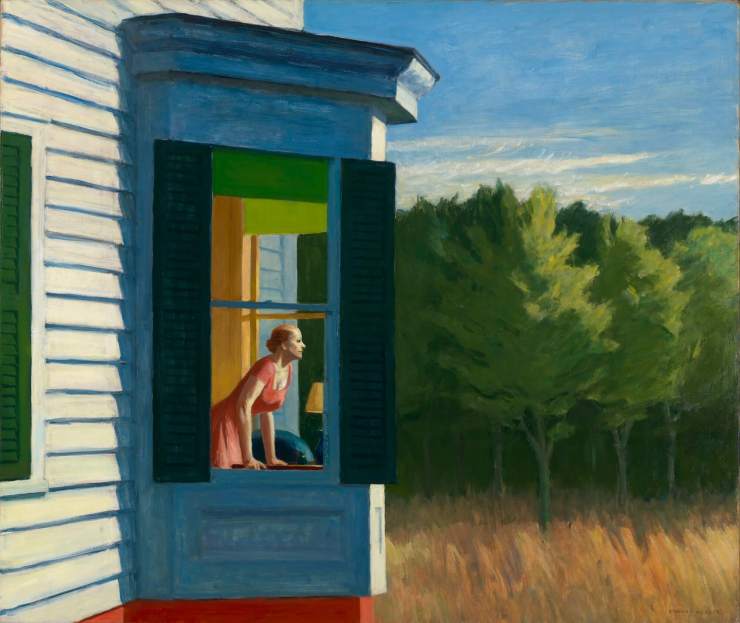
My favorite moment was when a taciturn visitor from Massachusetts — who emanated an “I’m-here-for-my-wife” vibe — started listing the architectural features of a house painted by Edward Hopper. Then he paused over a shutter delineating the almost-center of the painting. “That shutter is hung wrong,” he announced. Wow. I’ve looked at this painting many times and I had never noticed that. The visitor smiled. “You would have, if you’d ever hung a shutter!”
April 29: “In terms of finding a Mahjong set,” said the woman on my car radio, “I always recommend asking around, looking in second-hand marketplaces . . . or buying a new set on-line” Funny. I had just gotten in my car to visit my friend Maria, who has a gift for thrifting, an eye for on-line deals — and an extra Mahjong set. Would I like it?
You bet. I insisted on giving Maria a token amount of money, and she insisted on filling my arms with the Mahjong tiles, a playing mat, and three different zippered bags for all my accessories.
It’s difficult to win a Mahjong game without a joker. In my case, it’s utterly impossible to win without friends.

Readers, to receive notifications by email each time I make a post, just scroll all the way down this page (next to the “word cloud”), look to the left and click on the black button that says “Join Me!” And if you think a friend might enjoy these, please share the Delight!
If you’d like to browse my past delights, please consult the “word cloud” featured at the very bottom of this post. Find a theme or two that interests you and sift through the sands. Or learn a bit more about my Blog by visiting my Welcome page. You’ll also see links to four essays that were published in print magazines. I’m glad you’re here!


What a beautiful post with so much to savour as I sip my (second) cup of twa of the day.
LikeLiked by 1 person
Tea….
LikeLike
Thank you, Barbara, for your kind words. I just enjoyed my second cup of tea too. For my third, I’ll follow your example and drink from a pretty tea cup. You inspire me in more ways than you know!
LikeLike
Another delightfully busy week. Your SAAM tours sound great, I’m sure your groups are blown away by the experience. I’m fascinated by the idea of your directing your guests to lay down on the floor and look up at the ceiling. Sounds great…until it’s time to get up again. Ouch! Oh, the inestimable joy of old age. No wonder you only do this with school groups.
LikeLiked by 1 person
It’s true that the kids can (and will) do anything! But in this case, the slabs are bench-like ledges around the courtyard planters: very easy to lie back on. But oh, the core strength to sit up again! So, yeah, only with school groups…..
LikeLiked by 1 person
I had to look up where Alhambra is. It’s funny what people notice when they look at a painting. When I looked at Cap Cod Morning, I noticed the woman staring out the window. What is she looking at? The view? Or at someone she knows? Is she happy or unhappy? Didn’t even notice the shutter. 😉
LikeLiked by 1 person
Ooh, I want you in my tour group, Laurie! YES, we talk about all of those things and start to wonder about what she’s looking at (or for) and what emotions she might be experiencing. Hopper made the painting in 1950. Is there a returning soldier connection? The mystery is so compelling! (And thanks for saying that you, too, hadn’t noticed the shutter!)
LikeLiked by 1 person
Oh, I would love to be in your tour group! My orientation will always be with people rather than shutters. 😉 But, we need different kinds of thinkers, and it’s great that some folks notice shutters.
LikeLiked by 1 person