May 26: A recent docent field trip took us to the Washington Glass School & Studio, founded in 2001 by artist Tim Tate and other notables. We saw splendid pieces of art that both defied and augmented the glass medium, including colored glass ground into pigments and used as paint, as well as astonishing meldings of video and glass.
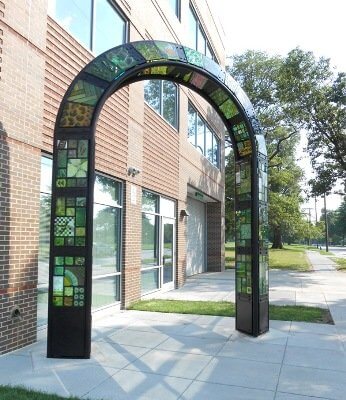
The studio specializes in public art. One commission — to build a glass-paneled arch in a neighborhood plagued by gangs — prompted fears of vandalism. The artists quickly invited gang members into the studio to help create the panels. One girl attended the workshops multiple times, and the studio put her panels front and center. At the dedication, the artists watched the gang members seek out their pieces and point excitedly, “I did that!”
With similar excitement, the docents helped create another piece of art. The medium this time, perhaps improbably, was polyurethane. The docents’ job was to rapidly spread the liquid color across the casting mold before it hardened and later to tweeze out unwanted bits.
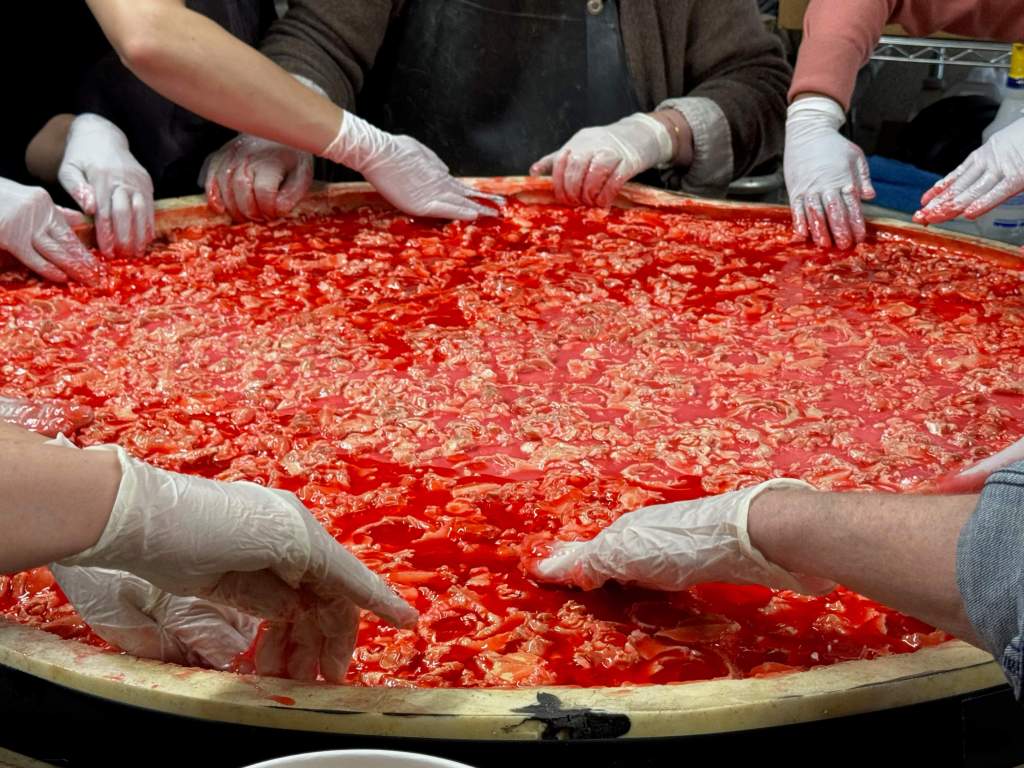
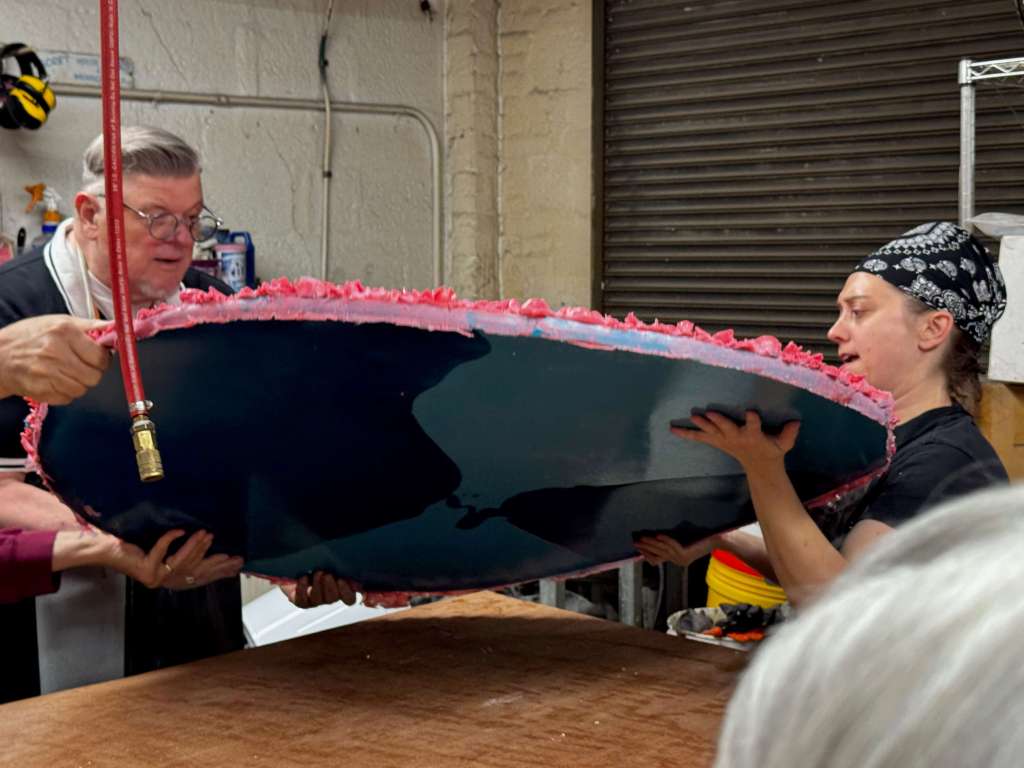
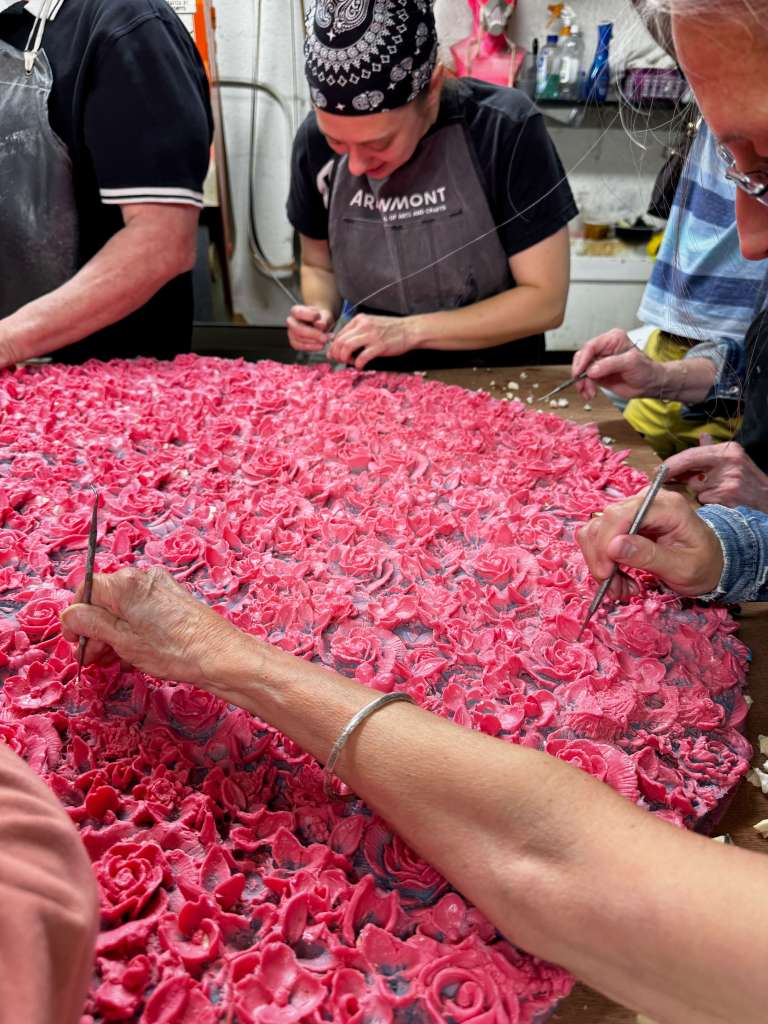
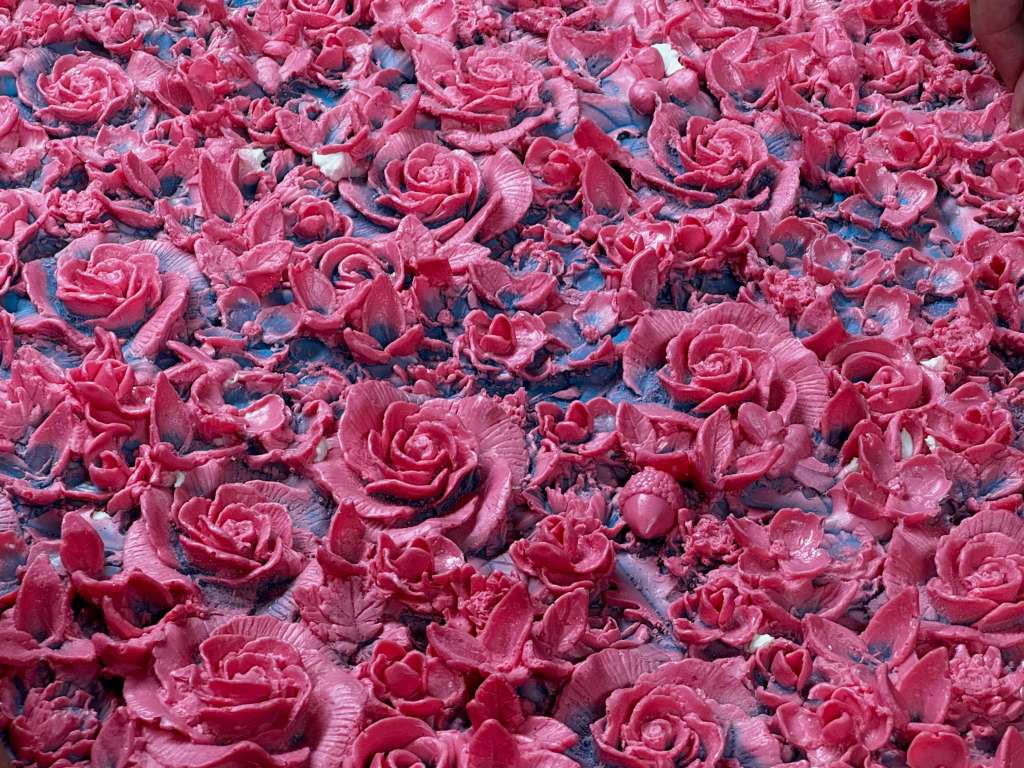
Eventually, the piece will appear in a local museum. When the SAAM docents visit that show, we’ll point excitedly and say, “I did that!”
Bonus: I did this too! Here’s an article in one of our local newspapers covering my May 24 Oakwood Cemetery tour. I’m grateful the journalist prepared people for the waiting list!
May 30: While Kevin embarked on an epic two-day, 150-mile bike ride from Richmond to Colonial Williamsburg and back again, I visited (surprise!) art museums.
Earlier in the week, I had meticulously planned every hour of my day in Colonial Williamsburg; today I tossed my plan into the gentle breeze and instead wandered for four hours in the DeWitt Wallace Decorative Arts Museum. There, for example, a musician playing a viol de gamba sweetened my study of a 1750s fire engine, the inventory of a coffeehouse proprietor (who owned “36 volumes Voltaires works”), and the paw prints of dogs (and one sheep) who had wandered through a brickyard of drying bricks in the 1750s — and in 2009.
I watched a 15-minute video — kudos to the person who came up with this idea! — of six historical interpreters dressing themselves (or being dressed) in 18th century garb: a “middling woman,” an “American Indian envoy,” a soldier, Lady Dunmore, a craftsman, an enslaved woman and a wiggling two-year old. I learned that the colonial men fastened their clothes with buttons; the women — even Lady Dunmore — relied entirely on laces and straight pins (quite close to the skin).
I watched a security guard interpret an object for a curious visitor, spied a placid baby in a stroller who looked exactly like a folk art painting, and was startled by a 1960s-era directional sign that I knew-without-knowing came from the Williamsburg Lodge, where my family stayed when I was little.
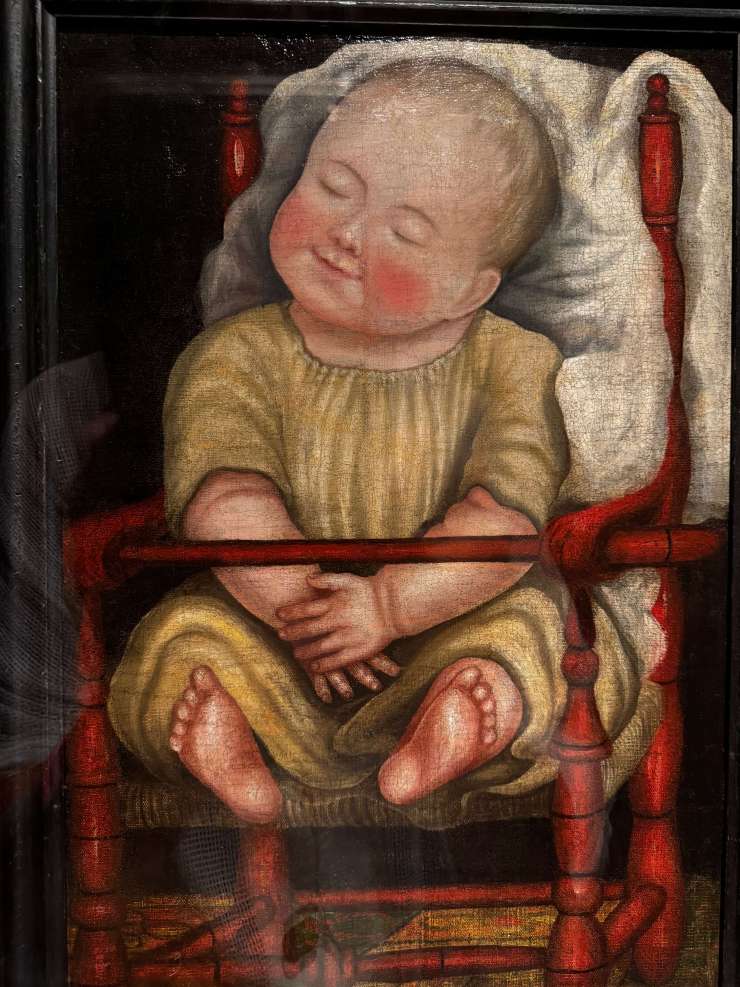
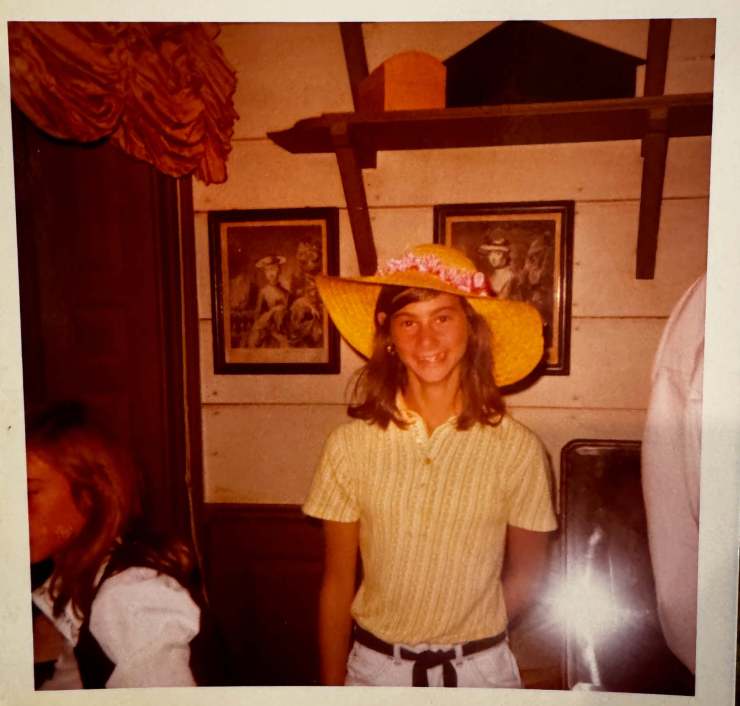
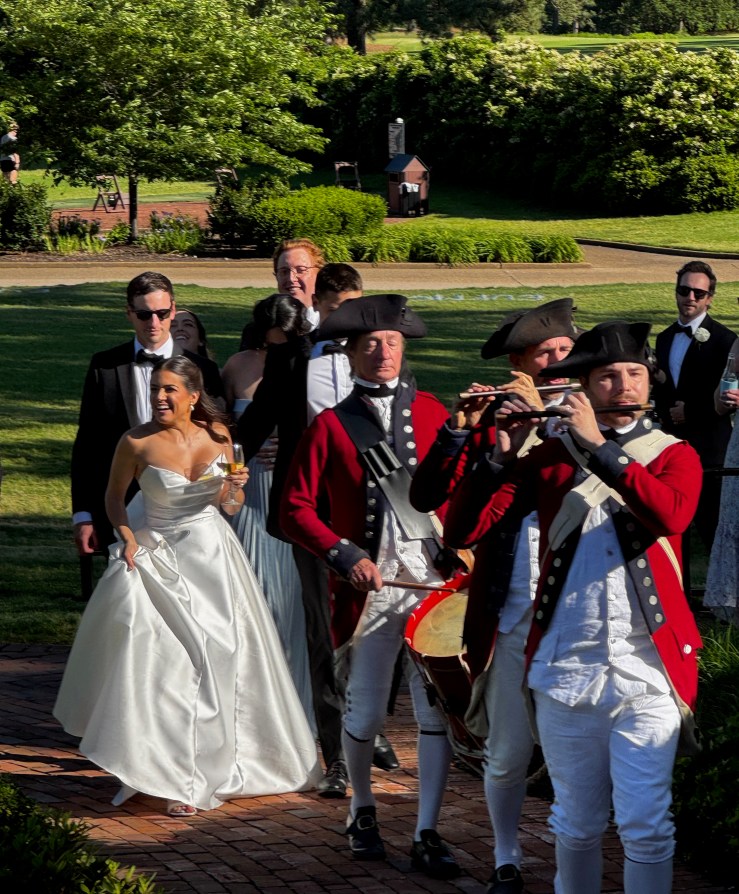
I finally left the museum and heard, in the distance, a parade of drums — and fifes! My ten-year-old legs would have run toward the sound. My older self just ran to the memories.
Bonus: It turns out I caught up with the fifes and drums. For more than two hours, I enjoyed the annual Colonial Williamsburg Drummers Call, a “Grand Review” of more than a dozen costumed fife & drum corps from up and down the East Coast and as far away as Wisconsin (“bringing their Midwestern sound”) and California. I cheered the Fort McHenry corps (the official fife & drum corps of the National Park Service), the Central York (Pa.) Middle School corps (from the only American public school music program offering a such a thing) and the alumni of the Colonial Williamsburg Fife & Drum corps (in khaki shorts, blue polo shirts and a smattering of gray hair).
As the alumni group took the field, I heard cheers of “Yeah, Grandma!” When all the corps marshaled to play Yankee Doodle in the grand finale, I added my own “Huzzah!”
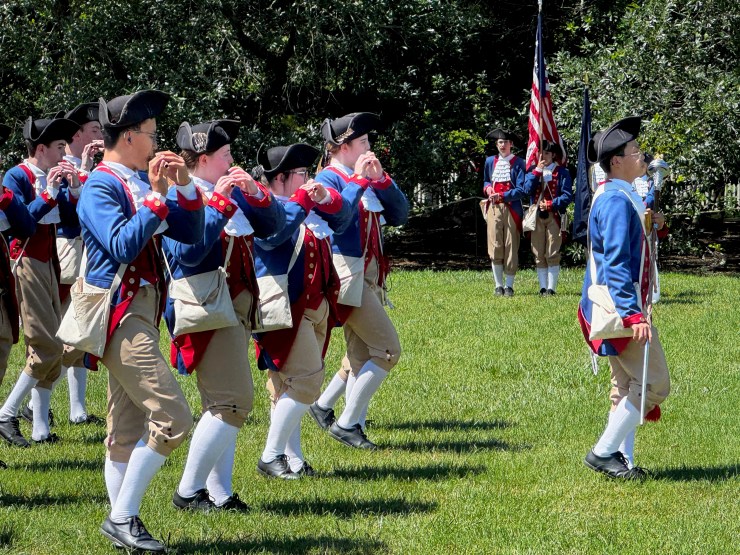
Double Bonus: I did adhere to one item on my original itinerary: a beer at the patio bar of the Williamsburg Inn — where this time the fifes & drums found me!
May 31: While Kevin spent a productive five hours on his bicycle today, I spent five equally productive hours at the encyclopedic Virginia Museum of Fine Arts in Richmond. I broke away from American art to explore Egyptian artifacts, Russian decorative arts (including more Fabergé eggs than at the Metropolitan Museum of Art) and wham-o examples of German Expressionism.
I wandered back to the museum’s outstanding American art collection, where I saw paintings that I coveted for SAAM and others that I coveted for myself. (How do these benefactors manage to remove such magnificent pieces from their walls to give to us?)
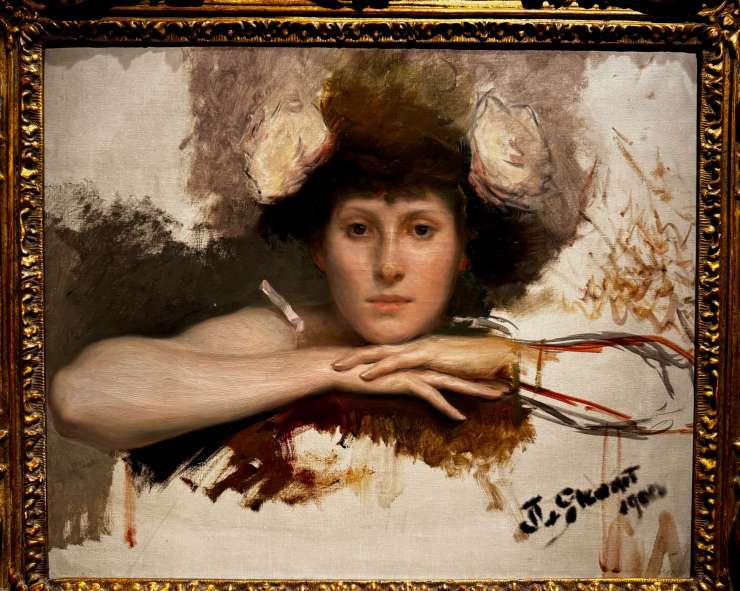
I stopped again and again. One painting, though, plopped the artist right next to me: a portrait of a confident 19th century woman that the artist — after completing only her face and one arm with luminous skill — proclaimed “finished,” signed the painting, and walked away. He even left behind his sketches of the unfinished arm, not to mention figments of her torso and background.
I was transfixed by this glimpse of frozen time. This glimpse of an artist’s undisguised choice. The contingency of it all.
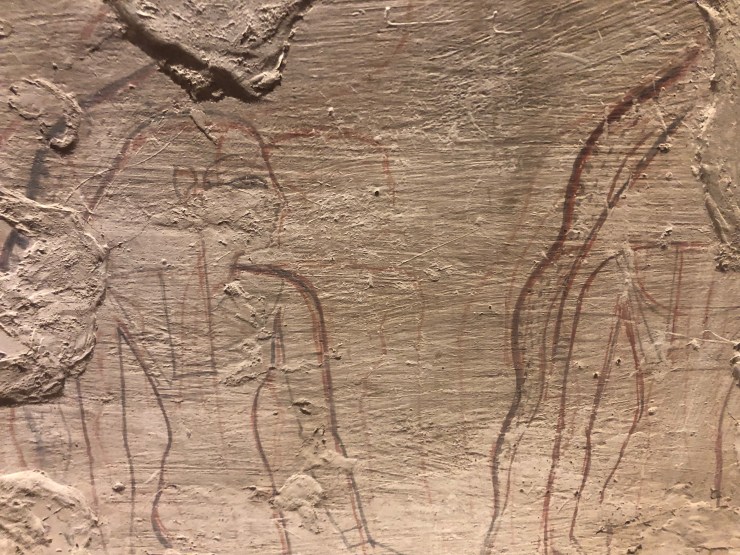
Two years ago, I had had exactly the same sensation in a lavishly decorated tomb in Egypt. While marveling — from a distance of three thousand years — at the skill of artists long dead, I encountered a wall painting interrupted in mid-composition. The painting was not yet beautiful. Had the pharaoh just died and the foreman called “pencils down”?
In that moment, I experienced a profound collapsing of time. I watched the long-dead artist lower his paint brush, pack his gear, and leave behind an unfinished work: nothing but gestures, ideas and corrections. He also left behind a glimpse of a master at work that I will never forget.
June 1: Needless to say — because my only artistic medium is words, not the tactile arts — I did not participate in the glass studio project. So, when my friend Allison invited me to visit a clay studio to make our own ceramic pieces, I needed to summon all the courage and risk-taking in my little heart to say — yes.
Allison generously said she was approaching our experience with the joy of early childhood, before “perfect” became an internal standard. Well, I struggle with perfect.
I also struggle with beauty. I like to eat my yogurt and berries from pretty bowls. I like to rest my toast on a pretty plate. I like to sip from a pretty mug.
When it’s done, my hand-painted bowl won’t be pretty. It might be quirky, charming, spirited. But not pretty, as I define pretty.
Maybe, though, there’s space on my breakfast table for something other than pretty. Maybe “spirited” is a good way to start the day. Maybe “brave” too.
Readers, to receive notifications by email each time I make a post, just scroll all the way down this page (next to the “word cloud”), look to the left and click on the black button that says “Join Me!” And if you think a friend might enjoy these, please share the Delight!
If you’d like to browse my past delights, please consult the “word cloud” featured at the very bottom of this post. Find a theme or two that interests you and sift through the sands. Or learn a bit more about my Blog by visiting my Welcome page. You’ll also see links to four essays that were published in print magazines. I’m glad you’re here!


The glass archway is a perfect piece of community. Love the girl with flowers in her hair. Once again you capture a beautiful set of experiences. Greetings this Friday from Porto!
LikeLiked by 1 person
Thank you, thank you! I’m delighted you like the girl with flowers in her hair. I couldn’t stop looking at it! And enjoy Porto. I hear it’s splendid. I’m eager to see it through your eyes.
LikeLike
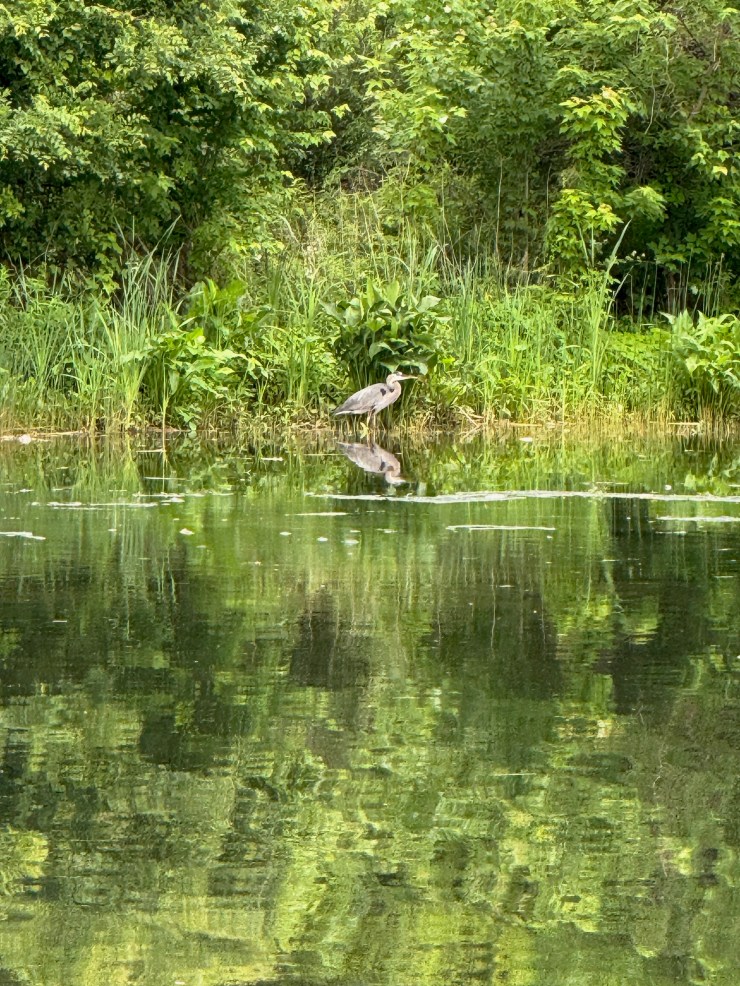
Where to start? I always ask myself this question after reading one of your rich, lively posts. I am going to start with what you featured last—that green, green photo of Kevin’s. How I love it. Please tell him for me.
Might as well jump back to the top. That arch is brilliant! As the idea of including members of the community to participate.
The article about graveyards was very interesting. So many stories, some good, some terrible.
I love your passion for art and the insights you share. I feel illuminated after reading your take on different pieces, and illumination, through various forms, is what I seek.
Finally, I hope you will show us your bowl when it is finished, in all its wabi-sabi gloriousness.
LikeLiked by 1 person
Reading your notes always makes me smile, Laurie. So cheery and encouraging and thoughtful, just like you. I’ll be sure to tell Kevin that you like his photo!
And, yeah, I’ll post a photo of my bowl when I’m done: I want to model vulnerability as well as appreciation for beautiful art. (Thanks for those words too!) Regarding vulnerability, I know my friends will cheer me on no matter what . . . Isn’t that the best part??
LikeLike
I am soooo enamoured with the 2 community art projects! The story of the glass sculpture and asking folks from different walks of life in to work on it …. Inspired! Best kind of graffiti & destruction prevention.
To participate in flower fashioning – wow!!!
LikeLiked by 1 person
”I love cemeteries”!
I just read the article about your tour – love your pink ensemble and “seeing” you in action! Wonderful!
LikeLiked by 1 person
You are such a wonderful sport, Ju-Lyn, to read that article. I’m now getting in a groove for these tours and having a lot of fun. It’s nice to know you are cheering for me in Singapore!
LikeLike
The video showing the practicalities of donning historical garb is a great idea – we tend to see such costumes as decorative rather than functional pieces, so it must have been enlightening to see the historical interpreters struggling (and I guess some did struggle!) to put them on. A follow-up video, filmed several hours later, could usefully include interviews with the wearers to get their views on how comfortable their costumes were…or were not!
I was interested to read that you are having a go at ceramics. Mrs P greatly enjoys clay modelling. She is neither an artist nor an expert, but loves the creative process. The clay meerkat she made for my recent BIG birthday sits proudly on the window ledge in our kitchen. It’s quirky and full of character, and I love looking at it every day. I hope your ceramic experience has given you as much pleasure as Mrs P gets from hers!
I love “Flowers in Her Hair”. I look at the image and am desperate to know that young lady’s story. Untold stories always draw me in…
LikeLiked by 1 person
Hi, Mr. P! Thank you for appreciating the costume video — I was entranced and watched for the full 15+ minutes. The actors didn’t struggle that much (except with the toddler!), but I did see things I wouldn’t have noticed, like all the straight pins used for the women’s garments. Ouch.
You’ve also given me a good topic for conversation with the next historical interpreter I encounter: how DOES that garment feel after a few hours? I’d also like to know what surprises them about their wardrobe. Thank you, as always, for your curiosity!
Ceramics: How great that Mrs. P. is talented in this way also. The birthday meerkat sounds perfect.
And, yes, I’d like to know more about the subject (and situation) of the unfinished painting. Maybe there’s a novel there…. (but not for me to write!)
LikeLiked by 1 person