September 6: I’m still daydreaming about becoming a docent at the Smithsonian American Art Museum. During my interview, we discussed my aptitude (and appetite) for leading tours of elementary school-aged children. To make my case, I recounted a story from my stint last year as a fourth grade substitute teacher.
One morning, the lead teacher told the kids that she’d miss the first two hours of class. She assured them, however, that things will be quite normal. “But,” piped up one boy who I swear reminds me of Jeremiah at that age, “I like weird.” I met his eye; I’ve got you covered.
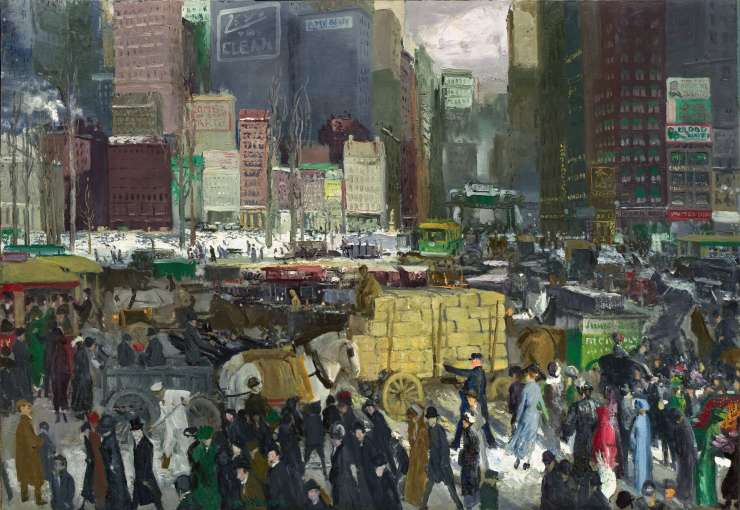
That morning in the Teachers Lounge, I’d stumbled upon educational materials someone had shared from the National Gallery of Art. Instead of “Simon Says” as our Morning Meeting activity, we would study the American painter George Bellows. I displayed Bellows’ painting of a somewhat chaotic winter street scene in New York City, circa 1911, and invited the kids to start noticing. They called out horses, wagons, hay bales, smokey skies, words written on buildings, women wearing long dresses, and no one walking around carrying cell phones. We talked about immigration, transportation, and urban sanitation (my favorite subject). Finally, after one boy laughed to see the word “clean” painted on the wall of a building, we discussed irony.
Weird enough? It all seemed perfectly normal to me.
September 7: Assateague Island, with its beaches and its horses, is right there. But clouds congregated overhead and the wind whipped. Definitely not a beach day. So my friend Kathy and I drove toward the 19th century. We landed in front of the massive Nassawango Iron Furnace, which from 1828 to 1850 produced pig iron from locally available bog ore, oyster shells, and charcoal. The oldest surviving hot-blast furnace in the United States, the structure had been hidden by forest and vines until the 1960s when the tower was excavated and its history explained.
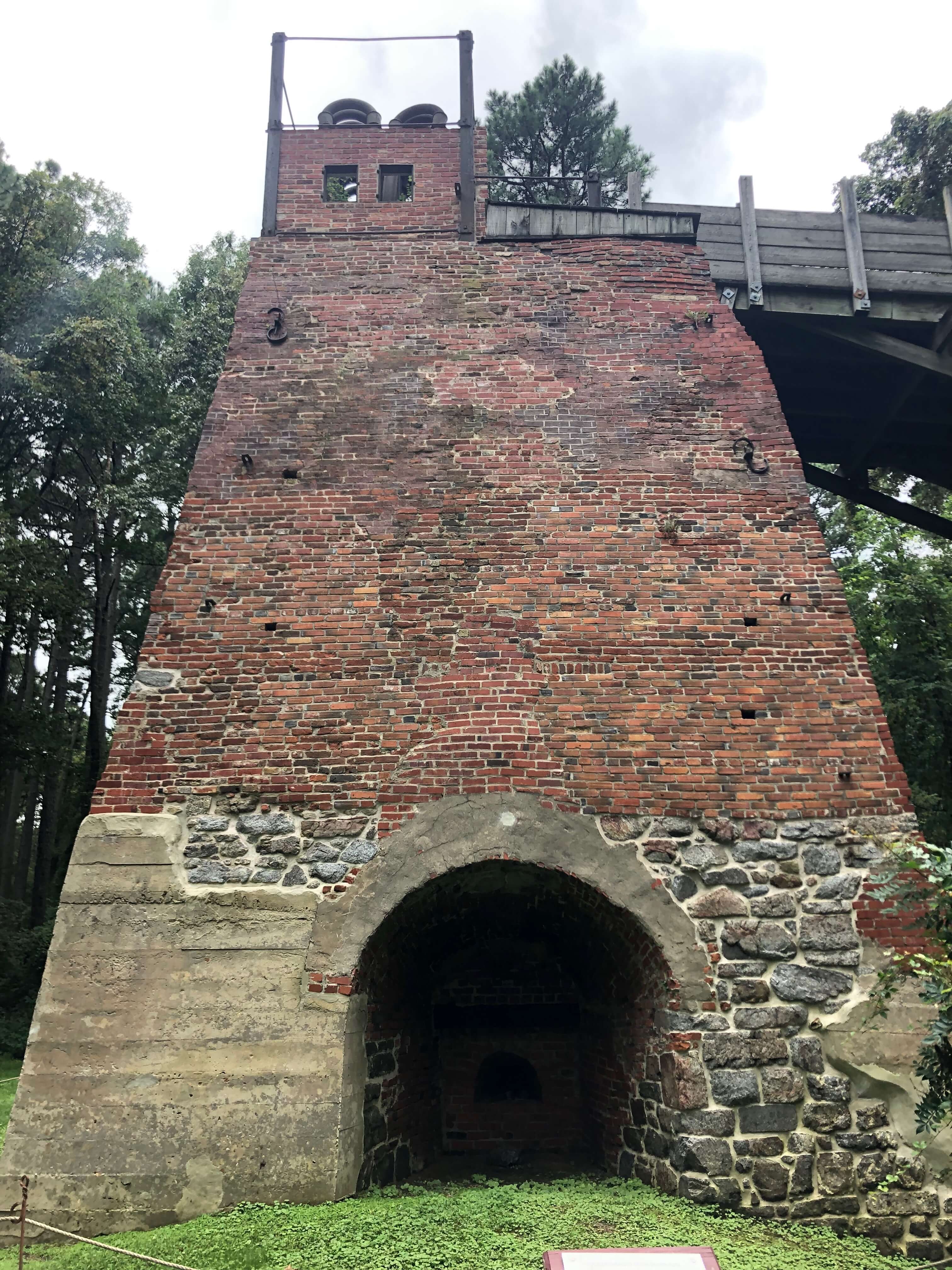
And so we learned that, through a series of chemical and biological reactions occurring in bogs and swamps, iron-rich groundwater produces chunks of ore. (That rich, rusty shimmer on standing swamp water is bog ore’s calling card; at twenty-year intervals, a single swamp can produce bog ore indefinitely.) From the Iron Age until its eclipse by iron ore mining in the late 1800s, the world’s innumerable iron products came from bog ore.
We walked up a rebuilt “charging ramp” to the top opening of the furnace, which received cartloads of bog ore, oyster shells, and charcoal. We then looked down on the grassed-over mill race that powered the water wheel that generated the necessary “hot blast” of air. And we hiked along the swamp and the canal that took the smelted iron out into the world. The whole thing was amazing.

September 8: Again declining to lounge at the beach (sunny, but chilly and breezy), Kathy and I instead hiked over a pedestrian bridge to Assateague Island. While horses grazed in the nearby salt marshes, we followed the trail over the sand dunes to the ocean. The sun was delightful. The sand was warm. The surfers were busy. “I just want to plop down here,” one of us said. And so we did.

September 9: I had ignored the network of cracks and feeble battery long enough. At last I yielded to Kevin’s pleas and traded up for an iPhone 15. How do I ——?! Where is my ——?! Does it even fit in my hand? As Kevin mused during the awkward first days with his own new phone, “It’s a brave new world.” Brave indeed. But am I?
September 10: “Hey, Daddy, do you want this pancake?” The little boy offered his dad a buckwheat-colored disc of sand. “No thanks, buddy,” his dad said. A bit later, his big brother proffered a handful of large clam shells. His dad accepted one. Then the big brother turned to the lady sitting a few yards away. “Would you like one?” Sure! He selected a good one and handed it to her. His little brother, observing this, scampered to the water’s edge to grab his own small fistful of shells. He ran directly to the lady and practically flung them into her lap. The lady smiled and thanked the little boy. The mom thanked her.
Much later, after the lady folded her umbrella, shouldered her chair and left the beach, I glanced over to her spot. She had taken the gifts with her.
September 10: Again this year, I’m leading an Adult Retreat in Bethany Beach, Delaware. For our discussions, we watched the Hallmark film “Five People You Meet in Heaven.” Here are some of our takeaways:
- Hate is a curved blade; if we can forgive, we are the ones healed.
- Our acts of kindness, large and small, matter in ways we may never know.
- Live your life as though it has meaning, because it actually does.
Unlike the main character, we didn’t need to wait for heaven in order to get the message.

Readers, to receive notifications by email each time I make a post, just scroll all the way down this page (next to the “word cloud”), look to the left and click on the black button that says “Join Me!” And if you think a friend might enjoy these, please share the Delight!
If you’d like to browse my past delights, please consult the “word cloud” featured at the very bottom of this post. Find a theme or two that interests you and sift through the sands. Or learn a bit more about my Blog by visiting my Welcome page. You’ll also see links to four essays that were published in print magazines. I’m glad you’re here!
 Fashioned For Joy
The iron furnace looks an interesting place to visit. Love the sentiment of Our acts of kindness, large and small, matter in ways we may never know. They do indeed.
LikeLiked by 1 person
The furnace was indeed surprisingly interesting and the museum did a very good job of interpreting it.
And thanks for saluting the movie’s admonition both to be kind and to understand the real impact that even tiny actions have. Our hero, happily, saw the many ways he had been kind (although he couldn’t add to the list). We, on the other hand, get to keep going. Your visit today, Barbara, certainly adds a sequin to your shiny pile!
LikeLike
Those are excellent takeaways from “Five People You Meet in Heaven.” So very true!
LikeLiked by 1 person
I agree with you, Donna. Maybe I should tape them to my bathroom mirror. Living them every day (even just a little bit) will make my life and those around me so much better.
LikeLike
I wish I’d had a teacher like you. What a great way to combine art appreciation and social history. I was never taught anything about art, and for many years my history lessons focussed on kings and queens and the wars they won and lost – the lives of ordinary folk just weren’t discussed until, in my mid-teens, I was introduced to a book called The World We Have Lost by Peter Laslett. It seems to me you also found a great way to introduce your class to a lost world, and to enable them to learn a bit about art at the same time.
I love that iron furnace. We have the remains of one – albeit much smaller – just a mile from here. Once again, a glimpse of a lost world.
You draw important lessons from “Five People You Meet in Heaven.” One in particular, “Our acts of kindness, large and small, matter in ways we may never know” resonates strongly with me. I recently reached out to a couple who were extraordinarily kind and generous to me over 40 years ago, to finally thank them. They were shocked, had no idea how they’d helped shape the rest of my life. I’m glad I told them.
LikeLiked by 1 person
Thank you, Mr. P., for your compliments on my teaching (it was a good day, highly dependent on serendipity!) and for the title of Mr. Laslett’s book. I’ll look for it. Regarding the furnace, I was very much thinking about you as I wrote that entry!
Regarding the movie’s messages, your story is lovely. And it was echoed by a few others at the retreat, who had the same experience: both being thanked and doing the thanking. Your kindness to that couple (and, oh, their delighted surprise!) surely reminded them — at a time when they might particularly have appreciated it — of *another* reason their life was meaningful.
And of course you get me thinking: who will I reach out to this week? (I’ll report back.)
LikeLiked by 1 person
why have I never visited Assateague Island?
LikeLiked by 1 person
Wonderful lesson with that George Bellows painting!
Wonder why it’s called “pig iron.” Later, I will be looking online to see if I can find the answer.
Lovely gifts from the sea.
Hate is a curved blade is a wonderful metaphor.
LikeLiked by 1 person
Thank you for noticing those tidbits, Laurie. If you discover the answer re: “pig” iron, let me know! And I appreciate your noting the “curved blade” metaphor. I thought it was apt too. Thanks, as always, for saying hello!
LikeLike
Hmmmm. That can change, Joy. I know somebody . . . .
LikeLike
Thank you for noticing those tidbits, Laurie. If you discover the answer re: “pig” iron, let me know! And I appreciate your noting the “curved blade” metaphor. I thought it was apt too. Thanks, as always, for saying hello!
LikeLike