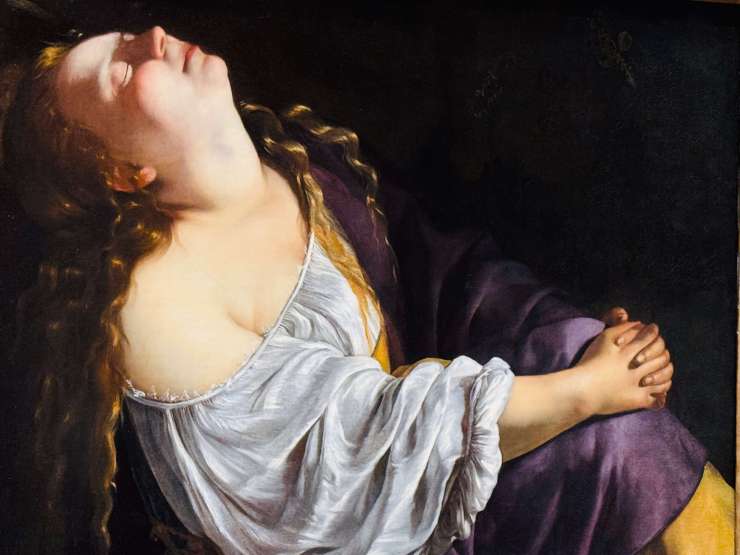
March 13: I stood transfixed before the National Gallery of Art’s newest and most acclaimed acquisition: Mary Magdalene in Ecstasy, the 1625 oil painting by Italian female artist Artemisia Gentileschi. My eyes took in the brilliance of the light, the softness of her skin, the intensity of her expression, and the dynamism spurred by line and shape. A man my age came to stand next me. “So this is what the fuss is all about,” he mused.
I nodded. Then he said, “I need to copy this.” I looked at him in wonder. “I’ve been a copyist at the National Gallery for thirty years,” he said, and proceeded to show me the painting through a copyist’s eyes.
“First, I would make the triangles,” he said, sweeping his hand downward diagonally from left to right and separating, Genesis-like, darkness from light. “Then I’d develop the oval of her skin, blouse and robe. And the colors! Olive here, blue here, a blossom of pink on her cheek.” (Ok, I added the “blossom” part.) We then talked about how Mary Magdalene’s face thrusts up and her hair cascades down, creating tension in their opposition.
We agreed that this is a pretty special painting and parted. Ten minutes later, we bumped into each other again, each of us heading to the 18th & 19th century galleries. My new friend led me to his work, a copy of a Hudson River School landscape. We talked about his technique, his process and the innumerable color challenges posed by a cracked and faded work. He estimated that he has about 30 more hours of work to do. Then he stuck out his hand. “I’m Bruce,” and we hugged. Goodbye, I said. “No,” he corrected, “I’d rather say, see you soon.”
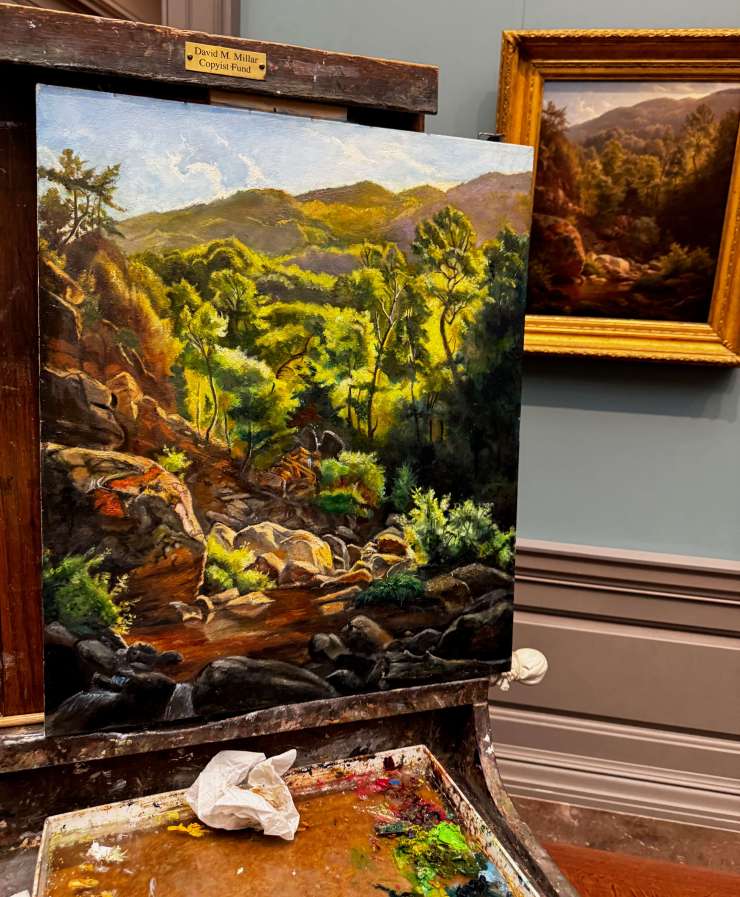
Bonus: You can see some of Bruce’s completed work here.
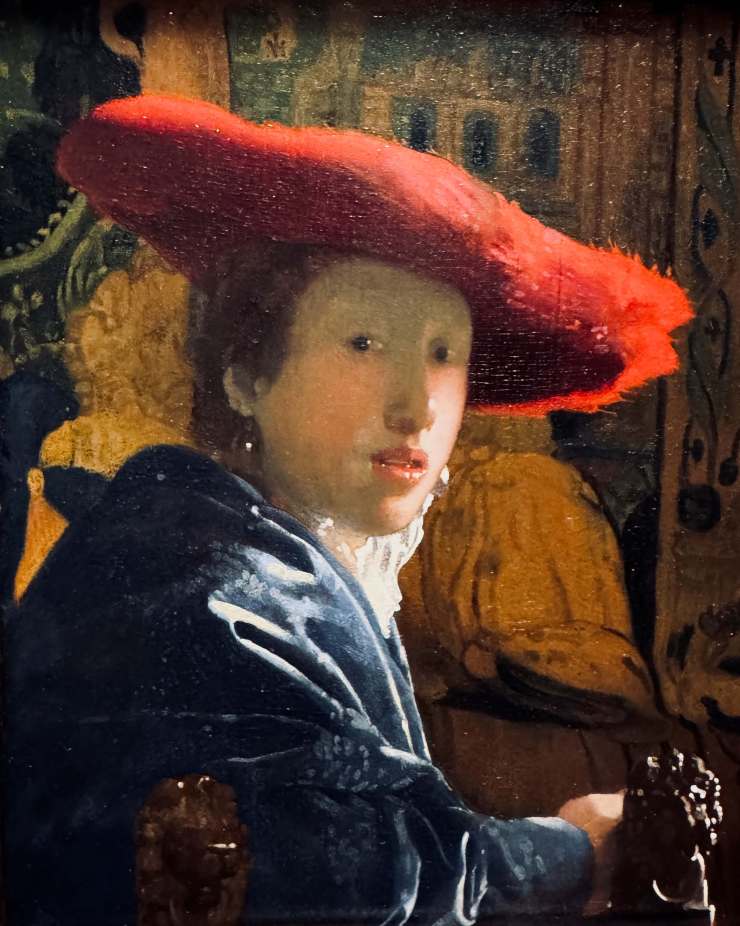
March 13: The National Gallery’s ladies room is decorated with faces of women painted by Vermeer, Renoir, Van Gogh, Cassatt and others. (What does the men’s room look like?) As I was washing my hands, I saw a young woman reaching into a stall occupied by someone with a garment bag puddled at her feet. Was the woman being dressed in a special gown? I lingered, hoping to see the be-gowned woman emerge.
But soon I saw she was actually disrobing in that tiny stall and that her friend was helping untangle various hooks and zippers. As I turned to leave, sending good wishes over the door, I was joined by the helping woman. Together we left the now-undressed woman behind. I looked at the helping woman questioningly: “Were you a stranger to her?” “Yes,” she replied. Then, perhaps thinking of the intimacies forced by circumstance, she added, “But not any more.”
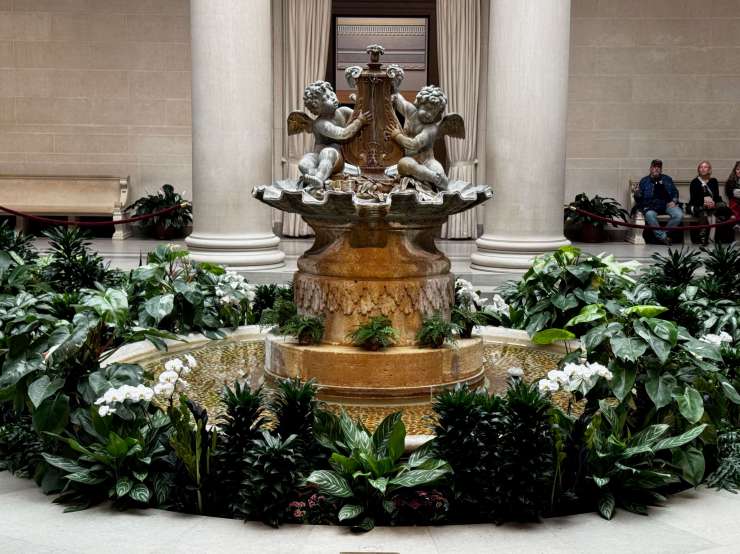
March 13: I was actually visiting the National Gallery today to attend a workshop called “Finding Awe.” Returning to the workshop from the ladies room, refreshed in body and soul, I came upon a fully gowned woman in the midst of her own wedding. The bride and groom clasped hands in front of their pastor in one of the National Gallery’s verdant interior courtyards. Joined by their families, a bunch of onlookers and two security guards, the pastor reminded the couple of their commitment today to choose each other, again and again, every day of their lives.
The pastor then led the bride and groom in their vows as some of us looked on teary-eyed. (Ahem.) Suddenly, seconds before the exchange of rings, the security guards moved in and shooed the pastor, bride and groom out of the courtyard. The denim- and sweatshirted-onlookers offered an encouraging cheer. The groom thanked us — strangers all — for bearing witness to their ceremony.
I headed back to my Finding Awe workshop. In our workshop, we had just discussed how awe can come out of nowhere, strike us with joy, and then vanish. We talked about how awe can be fragile, fleeting, unexpected and even precarious. We talked about how sometimes awe just happens, that you simply need to be open to the possibility of it.
I’ll raise my wedding toast to that.
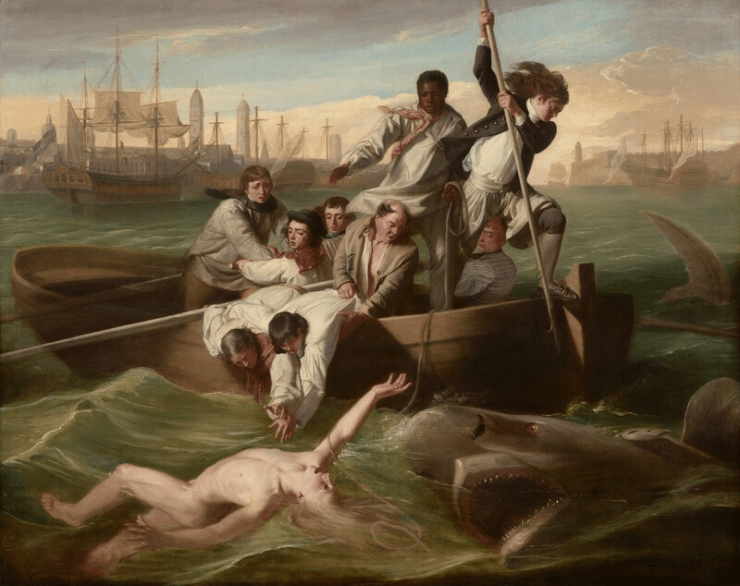
Bonus: Did I mention that the Finding Awe workshop focused on John Singleton Copley’s Watson and the Shark, a massive oil painting showing young Watson floating, naked and vulnerable, near both a wide-mouthed shark and a rowboat of sailors frantically wielding oars, a harpoon, extended hands and a rescue rope. At the very end of the workshop we learned that Watson’s rescuers were all strangers to him.
Coincidences can stimulate awe too.
March 16: The tranquilly named Our Lady Queen of Peace church practically roared in a cacophony of pre-worship conversations. Regular parishioners from L’Arche, a community of adults with intellectual disabilities, hailed people loudly and joyfully, and their exuberance was contagious. The priest’s welcome barely subdued the folks squeezing into the modest sanctuary, and the first hymn — offered at a jig-like pace by the choir’s stand-up bass, guitars, harmonica, tambourine, fiddle, keyboard and djembe drum — only revved people up again.
We calmed slightly as a deaf worship leader read and signed one of the readings. (Later, I watched her signing a new song, which we were all learning on the fly, by studying one of the singers who mouthed the words for her in an exaggerated way.) Then joy came winging back as we applauded birthdays and fist-bumped people from l’Arche who, from the front pew, greeted every single person receiving Communion. We finished — exhausted, in my case — with a song reminding us, “Your grace is enough, your grace is enough, your grace is enough for me.” Boy, today it was overflowing.
March 17: A very talented friend of mine recently started a new job. “How’s it going?” I asked. “It’s humbling.” She went on to say something like this: “I like being surrounded by smart people who are exceptionally good at their job. Sure, I like acquiring expertise. But I need to avoid slipping into complacency. I’d much rather be pushed every day; I’d much rather solve new problems and face tough challenges.”
Sound principles, I thought, to keep in mind as we turned together to join our annoyingly difficult barre class.
March 18: As you might know, last autumn Death Valley in California experienced a year’s worth of rain in three months — and now is studded with colors described in the New York Times as “lemony yellow, cotton candy pink and deep violet.” Naturalists — and our own eyes — remind us that Death Valley is actually a pretty desolate place and that rocks and cracked earth predominate. Still, for these weeks at least, there are also flowers.

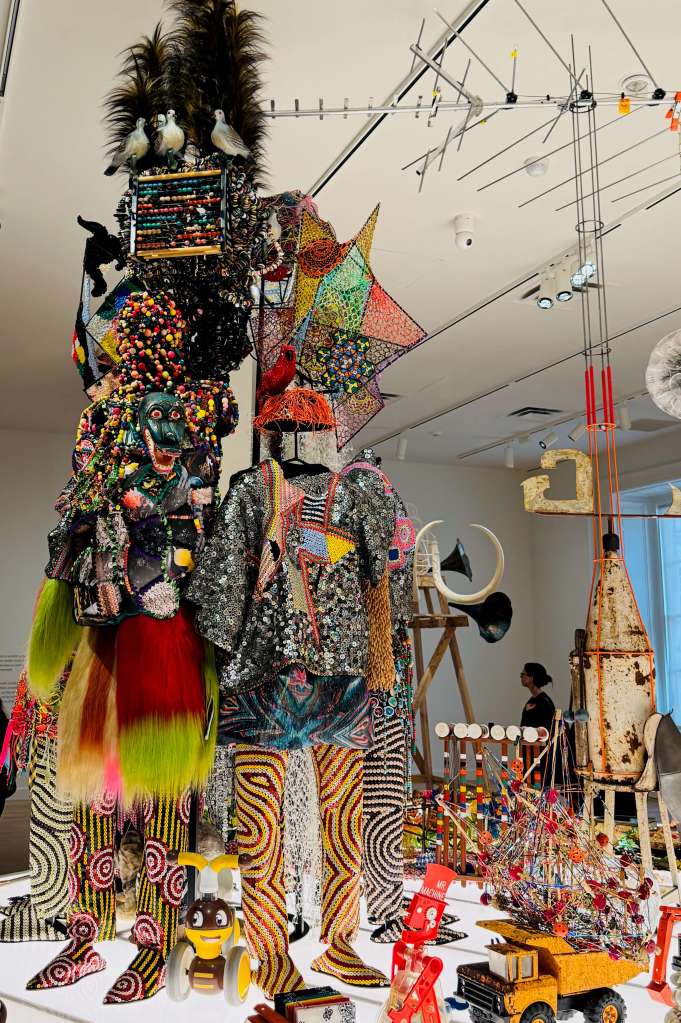
March 19: Last night, I scored one of the coveted free tickets to hear American visual artist Nick Cave and his partner, artist Bob Faust, discuss their work Mammoth. Commissioned by the Smithsonian American Art Museum nine years ago, this massive one-of-a-kind installation uses thousands of ordinary objects to explore identity and to excavate memory. It especially evokes Cave’s summers in Missouri with his six brothers on their grandparents’ farm.
Three rooms are populated with, among other things, bronze sculptures (and antique iron doorstops), a wall tapestry made of needlepoint and tin tea-trays, a three-walled video of a life-sized lumbering mammoth puppet on the shores of Lake Michigan, a thirty-yard mural draped in layers of beads, and an 800-square foot light table bearing a thousand objects that people of a certain age will recognize immediately.
Cave and Faust reported their astonishment and delight, when visiting the installation for the first time in public, how noisy the rooms were. No hushed solemnity here. Instead, they heard crowds of people exchanging stories and laughing with discovery.
As a catalyst to inspiration, Cave asked himself, “How was I made?” In Mammoth, Cave digs deeply through family artifacts, thrift store finds and his own expert needlework collections to answer this question and to invite us to do likewise.
I wonder, what would I put in my own mini Mammoth exhibition. What would you choose?
Readers, to receive notifications by email each time I make a post, just scroll all the way down this page (next to the “word cloud”), look to the left and click on the black button that says “Join Me!” And if you think a friend might enjoy these, please share the Delight!
If you’d like to browse my past delights, please consult the “word cloud” featured at the very bottom of this post. Find a theme or two that interests you and sift through the sands. Or learn a bit more about my Blog by visiting my Welcome page. You’ll also see links to four essays that were published in print magazines. I’m glad you’re here!
 Fashioned For Joy
What wonderful times you have been having, enjoying art in so many forms. Thank you for sharing your gorgeous delights this week.
LikeLike
Thank you, Barbara. I promise I’ll diversify someday, but for now I’m glad you enjoyed it!
LikeLiked by 1 person
What a lot of pearls on the string you have in your area, thanks, in large part, to the Smithsonian. Such a gem, and I hope everyone keeps this in mind in the upcoming years.
Nick Cave? Holy cats!
Are you ever at the museum when it is closed to the public? If so, perhaps you could sneak in to the men’s room to scope out what’s on the wall. 😉
I don’t know what I would choose for my own mini Mammoth exhibition. How to represent Maine and being Franco-American? Perhaps that’s why I write. I’m not as visual as other folks are. Still, it’s fun to think about.
LikeLike
Tee hee. I love the idea of sneaking in to the men’s room to answer my question. I do have closed-to-the-public visiting privileges at our wonderful Smithsonian (thank you for the salute!), but not the NGA. However, I could hover outside the men’s room door and interview bewildered users….
Funny about assembling objects for a light table of our own life & memory. You make such a good point. I too would struggle to use visual arts to capture my identify and memories. So, hurray for writing!
LikeLiked by 1 person
I will be waiting anxiously to hear about the men’s bathroom. 😉
Yes, hurray for writing as well as hurray for those who think visually. Wonderful to have a wide range of folks with different ways of seeing the world. Vive la difference!
LikeLiked by 1 person
As a paid up member of the male gender I recommend that you never sneak into a men’s room anywhere. At best you will be disappointed, at worst you will be appalled. You have been warned…!!!
LikeLiked by 1 person
“Random Acts of Kindness” can take many forms and are always to be applauded; I like to do them when I can. So far, however, I have never been asked to assist a young lady to undress herself in a public restroom. One day soon, maybe!?!
I am intrigued by your new friend Bruce. It’s clear that he is prodigiously talented, but is he not a bit frustrated when he copies the works of other artists rather than painting from his own observations and imagination? Or is the process of copying so demanding that it gives him all the satisfaction he needs?
And when Bruce says ““I’ve been a copyist at the National Gallery for thirty years”, is this an official role created and overseen by the gallery? If so, are there other artists fulfilling a similar role?
LikeLike
Thank you for your insightful questions, Mr. P. They inspired me to check the National Gallery of Art website https://www.nga.gov/employment-opportunities/copyist where I learned that one must apply for a special permit and meet certain requirements. I did notice that Bruce used a very old museum-supplied easel; apparently the museum supplies the drop cloth too. The website says that the NGA has issued over 8,000 permits since the program’s inception in 1941.
If I see Bruce today (he paints at the NGA on Fridays, which is when I attend the museum’s Awe workshops), I’ll ask him (in a very nice humble curious way) about his choice to invest hundreds of hours on copying and about the very special satisfactions he experiences from that challenge.
Regarding acts of kindness, first YES, I’m sure you find many opportunities. Regarding helping out in the ladies room, I think the best kindness is to remain on the outside!
LikeLiked by 1 person
I’ll be fascinated to hear about Bruce’s response. I have no artistic talent whatsoever, either as a creator or a copyist, and will therefore be interested to learn what makes him tick.
LikeLiked by 1 person
I am so touched and chuffed by your encounter with Bruce Campbell. To share space and conversation on heart/head/art matters with a master. Wowowowowowow.
Spending time in our National Gallery brings me great joy too. Hearing your stories delights me.
LikeLiked by 1 person
I really appreciate your insight, Ju-Lyn. I think one of the conditions for being a copyist is a willingness to engage visitors (who ask the same questions all the time!), a gift of education and superhuman patience and kindness. Bruce certainly exhibits all of these qualities!
And thanks, as always, for your loving encouragement!
LikeLike